Wednesday, June 20, 2007

Gordon Brown must drop his Claim

NEWS RELEASE

Wednesday 20th June 2007For immediate release

Gordon Brown must drop his Claim
“How can Gordon Brown, who took this oath, become Prime Minister of the United Kingdom?”
When Gordon Brown was an ordinary Scottish MP he signed the declaration of the “Scottish Claim of Right”. This document was a public oath committing those who took it to put the interests of the people of Scotland before all other considerations.

Now Gordon Brown is to become Prime Minister for the whole of the United Kingdom, the Campaign for an English Parliament is calling on Gordon Brown to publicly declare that he will not put the interests of any one part of the United Kingdom above any other part of the United Kingdom.

The Claim of Right, signed by Gordon Brown in 1988, read:

We, gathered as the Scottish Constitutional Convention, do hereby acknowledge
the sovereign right of the Scottish people to determine the form of Government
best suited to their needs, and do hereby declare and pledge that in all our
actions and deliberations their interests shall be paramount.

CEP Chairman, Scilla Cullen, said, “There is another nation within the UK- that of England. Will Gordon Brown extend to its people the right of self-determination that he espoused for his own nation when he signed the Scottish Claim of Right?”

CEP Vice Chairman, Tom Waterhouse, said, “The Claim of Right was a public oath, and those who took it pledged to put the interests of the Scottish people before all others. How can Gordon Brown, who took this oath, become Prime Minister of the United Kingdom? He must declare that he will put the interests of the whole of the UK before those of Scotland”.

National Council, Campaign for an English Parliament

Contact: cep-mediaunit@thecep.org.uk

Tuesday, June 19, 2007

CEP at West Mid Show

The Campaign for an English Parliament will have a stand at the Shropshire & West Mid Show at Shrewsbury this weekend.

Monday, May 28, 2007

Shropshire Star: Brown has no place as our PM

Brown has no place as our PM

Many people would agree with me that Gordon Brown has no mandate to govern England.

He hasn't contested an election as leader of the Labour Party and potential Prime Minister for a start - so much for his pledge to restore trust in democracy.

However, there is a more important reason why Gordon Brown has no mandate to govern England.

According to the Labour propaganda unit, Gordon Brown's domestic policies consist of health, education, housing and planning - none of which he has been given a mandate for by any part of the electorate.

In Scotland, "domestic" issues such as health, education, transport, the environment, housing and planning have all been made the responsibility of the Scottish Parliament.

Gordon Brown wasn't elected to the Scottish Parliament, so he has no say in those matters in his own constituency and his constituents didn't elect him for these policies.

As far as I am concerned, when Gordon Brown takes office this summer, England will be without a legitimate leader and Government

Stuart Parr
Brookside

Monday, May 14, 2007

Help needed at West Mid Show

Hi members,

Are any of you able to help out on the CEP stand at the West Mid Show held in June - if so please contact John Stanhope on 01902 630110.

Wednesday, May 02, 2007

Shropshire man given cancer treatment for free

A Shropshire pensioner who has been paying £3,000 per month for life saving cancer treatment that is free of charge on the NHS in Scotland will now receive his treatment free of charge from his Primary Care Trust (PCT).

John Green from Bridgnorth has been paying for Sorafenib Nexaval out of his own pocket because the National Institute for Clinical Excellence (National = England, of course, not the UK) hasn't approved the drug meaning that PCTs in England don't have to provide the drug when it's needed. In Scotland, the drug is available on free on the NHS because the Scottish government has an £11.3bn subsidy from the English taxpayer to spend on whatever they want.

Monday, April 23, 2007

Sunday, April 15, 2007

Shropshire Star: Scotland benefits while we pay out

Scotland benefits while we pay out

On April 1st the cost of prescriptions in England went up to £6.85 per
item. On the same day in Wales the charges were abolished.

In Scotland 92% of prescriptions are dispensed free of charge and MSPs only
narrowly rejected a bill to abolish them completely in 2005. It is only a
matter of time before they are abolished north of the border.

In Scotland pensioners are entitled to free public transport throughout the
country at all times and Northern Irish pensioners have just been given the
right to travel on public transport throughout Ulster and the Republic of
Ireland free of charge at any time.

In Scotland the elderly are entitled to free personal care in the care home
of their choice without having to go through means testing or selling their
homes.

In Scotland cancer sufferers get the newest and most expensive
treatments. The same applies to those suffering from dementia.

In England the same drugs are refused because the cost of the treatment is
more than the value the English NHS puts on a life.

In England we will shortly be required to pay to have a satellite spy box
fitted to our cars and pay per mile to drive on our roads. The same law
won’t apply to Scotland and Wales so they will be able to drive in England was
well as in their own countries without paying the road pricing tax.

The transport minister was elected in Scotland yet his department doesn’t
have a say in what happens to transport in Scotland.

Taking into account the above and the many other services our neighbours
receive it would be understandable for an Englishman to feel left out but there
is no need because we get something that our neighbours don’t - the
bill.

Stuart Parr
Telford

Monday, April 09, 2007

The Lord Kingsland replies

Dear Mr Higginbottom

'Thank you very much indeed for your letter of 25th March 2007 raising, essentially, the West Lothian question.

Although no final decisions have been made in the Conservative Party about our approach to the inequities that are inherent in the existence of Scottish, Welsh and Northern Irish legislatures, I am reasonably confident that the solution the Party will adopt is likely to be in the form of an English Legislative Committee within the UK Parliament at Westminster. This Committee would take decisions for England on those matters that are devolved to Scotland, Wales and Northern Ireland and would comprise Members solely from English constituencies.

With best wishes.

Mark Pritchard MP replies

ROAD PRICING AND DEMOCRACY IN THE UNITED KINGDOM Thank you for both your letters.
As you are probably aware, I was a sponsor of an Early Day Motion on road pricing and that EDM makes my position clear.
On funding for English counties and local authorities, I agree that the current Government has manipulated the Barnett Formula to strengthen its own heartlands, not only in Scotland and Wales, but also in some parts of the north of England. I agree there needs to be a review of how the funding formula is agreed.

As you are also probably aware, the Conservative Party is likely to publish in its manifesto that English law should be voted on by English MPs, perhaps by having a special English sitting day within the existing Westminster Parliament. Clearly the details of any such policy will be announced prior to the next election. I think this would deal with many of the democratic deficit points that you quite rightly raise.

Yours sincerely,

Owen Paterson MP replies

29th March 2007
Thank you for your letters of 20th March. I have made my position on these issues clear. As you know, there is a parliamentary convention which prevents me from taking on the case of another MP's constituent. You need to make your representations through Daniel Kawczynski.

Daniel Kawcznski MP replies

Dear Edward,

Thank you for writing again on the matter of an English Parliament, and for your kind words towards my family, we are indeed settling in very well to life here in Shrewsbury. / Shawbury

As for the points you raise there are many discrepancies in taxation, for example if looking at the amounts taxed and spent London gets the worse deal in the UK having almost £1 billion less spent there than it gives in tax. The Barnett formula although unfair on paper was established to account for the extra costs of the diverse and rural populations of Scotland and Wales, but also at the time there relative poverty. This does now need to be looked at again.

However it is not related to tax at all but to spending. The additional costs on prescriptions in England, despite being grossly unfair does not naturally equate to more money for Wales but rather fill the black hole created by Gordon Brown and Patricia Hewitt in the English NHS.

As to the idea of an English Parliament, I cannot support the idea of this being totally separate; the extravagant costs involved make the idea prohibitive, as should have been the Scottish Parliament. If the devolved matters to Scotland and Wales where to be debated in an English Parliament this would, or I believe should, be the same as the English members of the UK Parliament. First because it saves on the expense of further, unwanted elections, and secondly would stop another two hundred or more politicians in London, or elsewhere at the tax payer's expense. This is a similar argument as used against an elected second chamber. Furthermore it would probably be established under proportional representation which due to its nature and the nature of English politics would permanently favour a Liberal Labour alliance.

Aspects of Government would be I agree more complicated. Theoretically devolved departments such as Health, Education and Transport would have to be appointed by the Premier of the English Chamber, as opposed to the Prime Minister who would be for the UK as a whole. This I believe would be a compromise between a totally new Chamber and proper equal devolved government.

Thank you once again for continuing this debate with me.

Thursday, March 29, 2007

MEP's response to EU Democracy Requirements

Dear Mr Higgenbottom,

Thank you for your letter of 25th March regarding the campaign for an English Parliament and I reply on behalf of the three Conservative MEPs for the West Midlands as I cover the Shropshire area for the team.

As to your comments regarding that citizens of Member Countries should be able to participate in the political decision making process on an equal basis you are correct. However this is an issue which can only be resolved by the Westminster Parliament and, to my knowledge is being widely discussed.

As it is Westminster MPs who would make any decision by a vote in Parliament I have forwarded your letter to Daniel Kawczynski MP who is the Member for Shrewsbury and I am sure he will be in contact with you on the issues you raise.
Yours sincerely,

Philip Bradbourn OBE MEP

MP's response to EU Democracy Requirements

Dear Mr Higginbottom,
Further to your previous letter I am also pleased to write to you over the matter of devolution and the West Lothian Questions.
I have asked many times in the House why it is that Scottish MP's can vote on English matters and not vice versa. This is indeed democratically unfair. I support whole heartedly the calls for English votes on English matters.

I also have concern at present over the number of Ministers from Scottish constituencies who are in charge of ministries that only have jurisdiction over English constituents. This too is grossly unfair, and may get worse under a Scottish Prime Minister.
However such hypothesis will be answered if and when Mr Brown moves into Number 10. What is sure however is there is unlikely to be any change whilst he is in control, and the government relies on the Scottish members for its majority over English law.
I assure you that I take every opportunity to raise this matter I in the House, or via questions.
Daniel Kawczynski MP

MP's response to Barnett

Dear Mr Higginbottom,

I would like to take this opportunity to respond to your letter on March 20th regarding the Barnett Formula, and how it may affect the potential subsidising of Welsh and Scottish constituents.

My understanding of the Barnett Formula is that it relates to spending and not taxation directly. As such any extra monies raised will be returned to the treasury, who will then decide where best to allocate the funds. The Barnett Formula only comes into effect when these additional funds are allocated from the treasury for spending within England, when this occurs some extra money is also released to its Welsh and Scottish counterparts in order to maintain the same standard of service.

However, I can understand, and share your concerns over the issue, The Barrett Formula is certainly one aspect of government policy I would like to see re-examined in order to try and establish a fairer system.

Also to address your concerns over potential road pricing I would like to assure you that I am opposed to the idea, as I believe it may harm our constituency.

Thank you for taking the time to let me know of your concerns, I hope that this letter has managed to allay some of your fears.

Regards,
Daniel Kawczynski MP

EU Democracy Regulations

Daniel Kawczynski MP
House of Commons
London
SW1A 0AA


Dear Daniel,

It is my understanding that one of the criteria for European Union membership is that all citizens of a member country should be able to participate in the political decision making process on an equal basis.

If I am correct in this understanding then this is manifestly not the case in the United Kingdom. People in England only elect one law-making representative – to Westminster – who deals with all issues. The people of Scotland however get to elect two representatives to deal with the same matters – one to Westminster and one to Holyrood. This means that England is underrepresented. Conversely, it could be argued that the people of Scotland are being adversely treated – they are being ‘fobbed off’ with most issues being dealt with by an inferior and subordinate parliament – a case of getting the “monkey” not the “organ grinder”.

Either way, the people of England and Scotland are not being treated equally.

Worse is yet to come. It looks likely that Gordon Brown will become Prime Minister of the UK. He is of course only elected by his Scottish constituents to represent them in Westminster on matters such as national taxation, defence, foreign affairs etc. He has no mandate from them (or anyone else) to deal with health, education etc but the bulk of the PM’s job is to oversee such issues in England.

This is hardly equitable treatment. It is a form of apartheid, a person with no electoral mandate governing a majority of the people. If the people of England were black this would incur the wrath of the United Nations, let alone many others.

The Conservative Party seems to me to have decided to sit on its hands, allowing the current iniquitous situation to continue. I believe the Party thinks that by the next election it and Dave Cameron will be popular and Gordon Brown and Labour won’t. But, “There’s many a slip ’twixt cup and lip.”

Any self-respecting representative of the people of England should not be merely “letting sleeping dogs lie” but should be doing their utmost to redress the situation by one means or another rather than being complicit in the continuation of a travesty of democratic inequality. After all, article three of the Acts of Union 1707 also requires “one and the same parliament”.

Perhaps you will be good enough to advise me whether my understanding of the EU’s democratic requirement is correct.

If it is, perhaps you can advise me what you and your Party are doing to redress the situation and to “report” the UK to the appropriate “authorities or court”.


Yours sincerely,

dward Higginbottom
Co-ordinator, Shropshire Branch of the Campaign for an English Parliament

Barnett Formula & Prescriptions

Daniel Kawczynski MP
House of Commons
London
SW1A 0AA


Dear Daniel,

I am writing to all of Shropshire’s Members of Parliament on behalf of CEP’s local membership.

As you will be aware, NHS prescription charges will be raised in England as from 1st April whilst they will be abolished in Wales.

As I understand the Barnett Formula it will mean that this increase of tax levied on the patients of England will automatically result in a proportion of the extra monies being ‘hived off’ to Scotland, Wales and Northern Ireland. Neither Scotland nor Wales appear to need this extra money as they already have a better funded NHS than England does.

Likewise, the Government is toying with the idea of introducing a ‘road pricing’ tax. The Scottish Parliament and the Welsh National Assembly have however indicated that they would not introduce this system.

As I understand the Barnett Formula it will mean that this new tax levied on the motorists of England will automatically result in a proportion of the extra monies being ‘hived off’ to Scotland, Wales and Northern Ireland. Neither Scotland nor Wales appear to need this extra money as they have no intention of introducing ‘road pricing’.

Can you confirm that your understanding of the Barnett Formula is the same as mine?

If my assumption about the Barnett Formula is correct, I cannot see how any self-respecting MP representing an English constituency can countenance this manifestly unjust situation. Perhaps you can advise me and my fellow members of your and your Party’s position on the issue.

Thursday, February 01, 2007

Suprise! Mr Blair

Our illustrious leader, Tony Bliar, visited Telford today at short notice.

Happily, CEP Shropshire was tipped off and myself and another member - Derek Armstrong - greeted him with a 30ft banner saying "English Parliament Now".

No pictures unfortunately as we missed the Shropshire Star photographer but Bliar certainly couldn't have missed the banner.

Friday, November 10, 2006

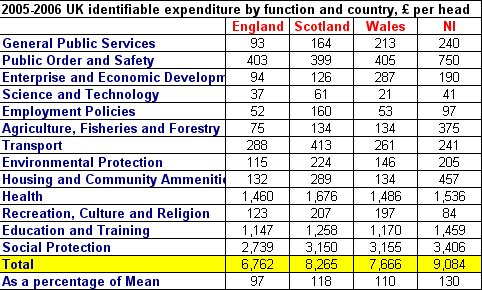
I want my money back!

Figures from UK Treasury:


">Click here for more details.

Saturday, September 16, 2006

Letter: Shropshire Star

Change to voting will not affect the nation

Gordon Brown kicked off his leadership campaign with a speech on Britishness in Scotland, the least British part of the UK.

In his speech he said: “The SNP want Scotland separate from the UK and want to force Scotland to choose between Scotland and Britain”.

On the Tories he said: “The Conservatives want English votes for English laws and want the English to choose between England and Britain”.

On the former he is correct and I personally wish the SNP the best of luck. The sooner England loses the financial, social and political liability that is Scotland the better. We could spend the £11.3bn annual subsidy on cancer treatments in England instead.

On the latter, however, he is way off the mark. The Tories are merely trying to find a way of stopping MPs elected in Scotland - such as Gordon Brown - from voting on matters that only affect England. As Gordon Brown can do next to nothing that affects his own constituency in Scotland, banning him from interfering in English affairs would leave him with next to nothing to do.

English votes on English legislation is a fatally flawed idea but at least the Tories are recognising that there is a problem.

Contrary to Gordon Brown and Labour’s assertions, banning MPs not elected in England from voting on English legislation or even establishing an English Parliament, will not lead to the break-up of the union. Giving Northern Ireland, Wales and Scotland their own devolved governments hasn’t lead to the break-up of the UK so there is little reason to believe that merely evening the political inbalance in England would.

Stuart Parr
Telford

Saturday, September 09, 2006

letters to shropshire newspapers

I am proud to be English even though that may be a politically incorrect thing to say. I used to be proud being British, but that was taken away in 1997 when Tony Blair and his crew set out to make me a third class citizen within the UK.

Despite being the oldest unified country in Europe with more than a thousand years of continuous history, as far a Westminster and Brussels are concerned, England does not exist. The Encyclopaedia Britannica says: ‘Despite the political, economic, and cultural legacy that has secured the perpetuation of its name, England no longer officially exists as a governmental or political unit unlike Scotland, Wales, and Northern Ireland.’

When Gordon (please let me be prime minister) Brown is pontificating about ‘the nations and regions of Britain’ he is using Labour speak for Scotland, Wales and Northern Ireland (as the nations) plus the Euro regions that cover the area once known as England. Labour has no love for England, its most ardent support have always come from Scotland, Wales and the immigrant communities, that’s presumably why they have let 500,000 more in during the last twelve months or so. Scotland, incidentally, only has about 1% of the UK’s immigrants despite having more than 30% of the land surface.

You might think that the Conservatives would champion equitable treatment for England, after all 94% of their votes in the 2005 General Election came from here, but no. They are, for reasons best known to themselves, obsessed with ‘preserving’ the Union at all costs, even if that means perpetuating apartheid against the people in England.
Annabel Goldie, leader of the Tories in Scotland, said at the beginning of September: ‘David Cameron and I will deliver the Parliament and the policies which Scotland needs, and its people deserve.’ But evidently ‘Dave’ has no similar plans for the downtrodden suckers of England who are bled dry to give our fellow ‘British’ citizens a better lifestyle.
It’s not just Herceptin where England’s peoples get third best; there are other cancer drugs too that are not available here in this part of the UK. Our NHS, education, public transport, treatment of the elderly and more, are grossly under-funded when compared to the rest of the UK.
A MORI poll published on 8th July 2006 showed 41% of those living in England were in favour of an English Parliament. Wales got its Assembly with only 25% of its voters saying ‘yes’, Scotland its parliament with 46% of its electors saying ‘yes’.
We in the Campaign for an English Parliament are not party political, we are simply trying our best to rouse the people of England to stand up for themselves and their country. Join us before it’s too late.
Yours sincerely,

Edward Higginbottom
Co-ordinator, Shropshire Branch of the Campaign for an English Parliament